
AI FILMMAKING - WORKFLOW CASE STUDY
The Applause: Buildinga Cinematic AI Short Film
Featured film: The Applause
A behind-the-scenes look at a dystopian AI short film about propaganda, obedience, masked resistance and the moment a crowd stops performing loyalty.
 Watch film

Written by
Alex Bokor Genial ProductionThe Applause is a cinematic AI short film set inside The One Republic, a dystopian authoritarian state where applause has become proof of loyalty.
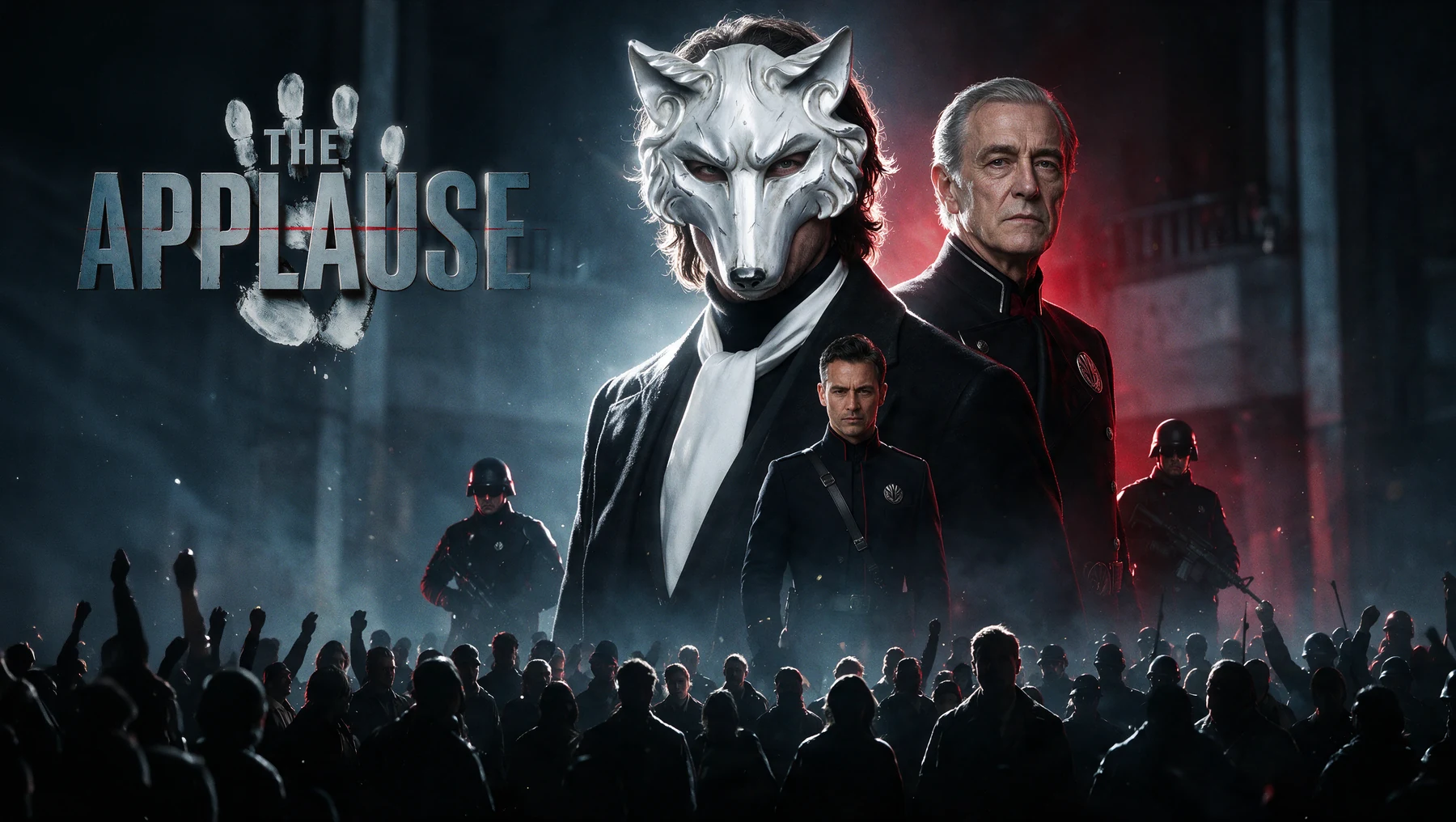
The film follows three characters during the collapse of a regime: Chancellor Kain, the ruler who demands public worship; Rook, his political operator who wants to inherit power; and The White Wolf, the masked rebel figure behind The Silence. In this world, silence is dangerous. When a crowd in Unity Square refuses to applaud Kain, the entire political ritual breaks.
This article breaks down the AI filmmaking workflow behind the project: writing, visual development, shot design, Seedance 2.0 video generation through Higgsfield AI, editing, subtitles, sound and final finishing. The goal was to make an AI generated short film that feels directed, not assembled from disconnected clips.
What Is The Applause About?
The Applause is a dystopian AI film about a regime that turns public approval into a survival mechanism. Applause is no longer a reaction. It is a political signal. To clap is to obey. To stay silent is to become visible.
The story begins as a public speech in Unity Square and turns into a rebellion. Chancellor Kain expects worship from the crowd. Rook watches for opportunity. The White Wolf waits for the exact moment when the crowd realizes it has power. What begins as ceremony becomes collapse.
The World of The One Republic
The One Republic is an authoritarian state built around performance. Its buildings, flags, uniforms and public rituals are designed to make obedience feel normal. The world draws from the visual pressure of a V for Vendetta inspired AI film and the psychological atmosphere of a 1984 inspired dystopian film, but the story has its own central rule: loyalty must be heard.
Unity Square became the main stage for that rule. The crowd is not background texture. It is the pressure system of the film. Every face, flag and balcony angle had to support the same question: will the people keep performing loyalty when the performance stops protecting them?
Main Characters: Kain, Rook and The White Wolf
Each character was built around a different relationship to power. Chancellor Kain needs worship. Rook wants inheritance. The White Wolf removes the performance. That triangle gave the cinematic AI film a clear dramatic structure before any shots were generated.
Kain is the face of the regime. His presence needed to feel ceremonial, controlled and almost religious. Rook is colder and more practical. He is not loyal to Kain as a person, only to the machine Kain built. The White Wolf is the opposite of both: masked, quiet and symbolic, a figure designed to make silence contagious.
The AI Filmmaking Workflow
The Applause was built through an AI-assisted filmmaking workflow combining writing, visual development, shot design, video generation, editing and sound. The production was treated like a real film pipeline: story first, references second, shots third, final edit last.
Writing and Shotlisting with ChatGPT Codex
The script, scene structure, dialogue revisions, shotlist and prompt direction were developed with ChatGPT Codex. Codex was used as a writing partner, continuity checker and director-style prompt assistant, helping transform the story into a sequence of cinematic scenes with clear blocking, camera movement and emotional beats.
Creating Visual Assets with Nano Banana Pro, GPT Image 2 and Seedream 5 Pro
The visual asset pipeline used Nano Banana Pro, GPT Image 2 and Seedream 5 Pro to create and refine character references, locations, props, title graphics and atmosphere frames. These assets helped maintain consistency across the world of The One Republic, including wardrobe, color palette, lighting, political symbols and character identity.
Generating Cinematic Video with Seedance 2.0
The video scenes were generated with Seedance 2.0 through Higgsfield AI. Each generation was treated like a directed film shot, with specific duration, framing, camera movement, acting notes, weather, lighting, continuity constraints and final-frame control.
Keeping Visual Continuity Across AI Generations
Continuity was the main challenge. A generative AI cinema project can look impressive shot by shot and still fail as a film if the world keeps changing. The Applause needed the same political symbols, the same costume language, the same public square and the same emotional temperature across different generated scenes.
The solution was to treat every prompt like a contract. Characters had defined wardrobe, posture and power status. Locations had fixed roles. Unity Square was not just a location. It was the stage of the regime. The White Wolf was not just a masked character. He was the visual language of refusal.
Sound, Subtitles and Final Editing
The final film was assembled through editing, subtitles, sound design, music selection and upscaling, with the goal of making the AI-generated material feel like a coherent short film rather than a collection of isolated clips. The edit had to preserve the ritual: speech, expectation, silence, collapse.
Sound was especially important because the film is about public reaction. Applause, silence, crowd pressure and political speech all had to feel connected. Subtitles helped keep the story readable without flattening the cinematic mood. Topaz Upscale was used in the finishing stage where enhancement was needed.
What This Project Taught Us About AI Filmmaking
The Applause confirmed a simple production lesson: an AI generated movie still needs direction before generation. The models can create scale, atmosphere and motion, but they do not automatically create meaning. Meaning comes from the story system.
- Start with a strong social rule. "Applause is proof of loyalty" made the world instantly understandable.
- Make every character represent pressure. Kain, Rook and The White Wolf each pulled the regime in a different direction.
- Use tools by role. Codex handled structure and prompt direction, image models handled references, Seedance handled motion.
- Reject beautiful drift. A shot that breaks the world is not useful, no matter how cinematic it looks.
- Edit for the idea. The film works when silence feels more powerful than noise.
For Genial Production, this is the same lesson that applies to AI commercials and branded films. AI production is strongest when it has a clear creative rule, a controlled visual world and a final edit shaped by human taste. You can see the same production logic in our Meridian AI short film case study and the Dacia Striker AI spec commercial.
FAQ
What is The Applause?
The Applause is a dystopian AI short film about a regime where applause is proof of loyalty and silence becomes rebellion.
What AI models were used to create The Applause?
The film used ChatGPT Codex for writing and prompt direction, Nano Banana Pro, GPT Image 2 and Seedream 5 Pro for visual assets, and Seedance 2.0 through Higgsfield AI for video generation.
Is The Applause fully AI-generated?
The film was created through an AI-assisted workflow, with human direction, writing decisions, editing, sound choices, visual curation and final production by Alex Bokor and Genial Production.
Is The Applause inspired by V for Vendetta or 1984?
The film belongs to the same dystopian conversation: masked rebellion, authoritarian spectacle, public obedience and fear of silence. It uses those influences as atmosphere while building its own world, The One Republic.
Need a cinematic AI short film, branded story or campaign world built with a real production workflow?
Start a Brief