
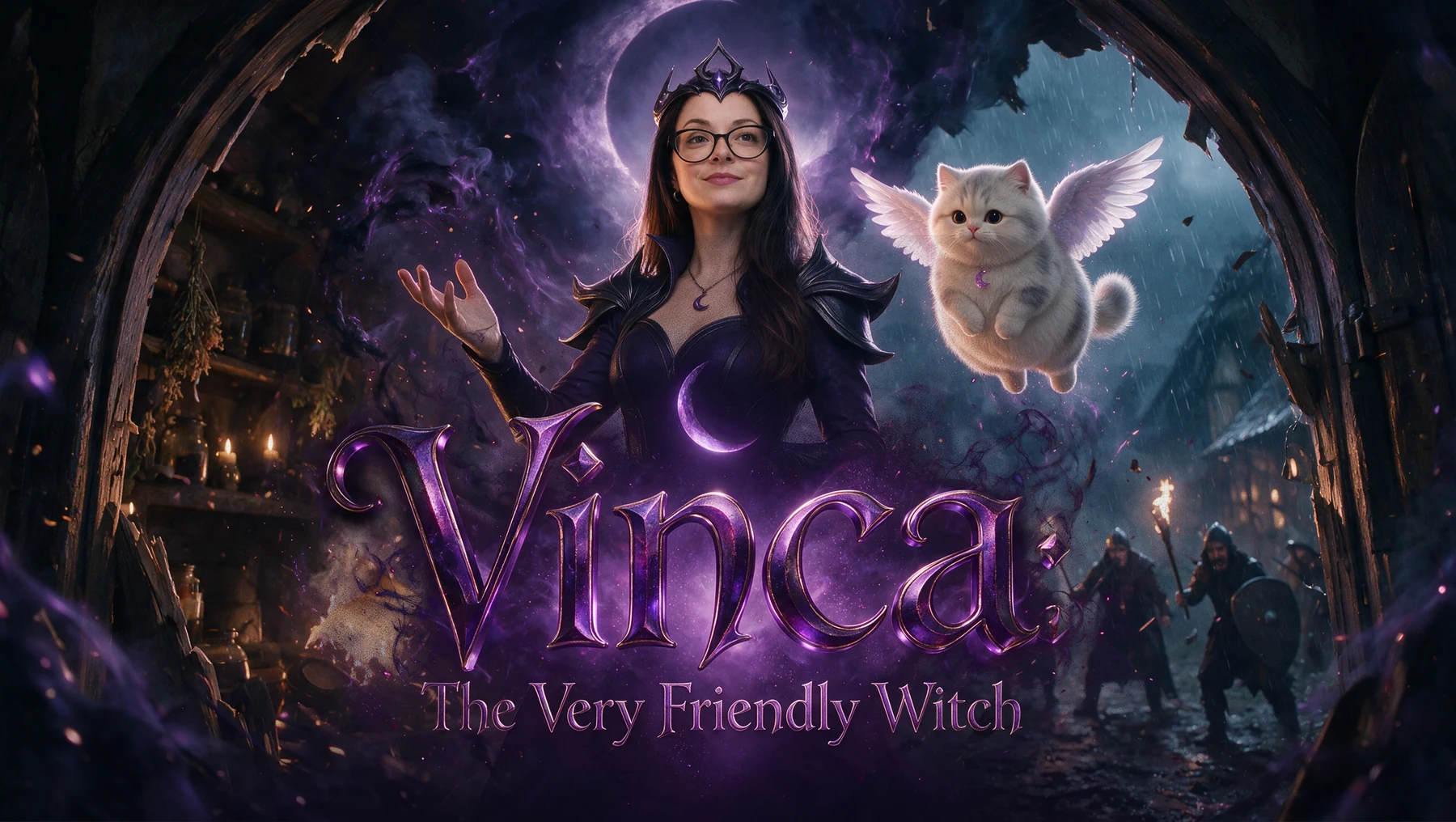

Vinca: The Very Friendly Witch is a cinematic AI dark fantasy comedy about a medieval witch-hunter raid that breaks into the wrong cottage.
The hunters expect a monster. Instead they find Vinca, a warm, polite, teacher-like woman in glasses who offers tea, apologizes when magic goes wrong and asks everyone to mind the rug. The joke is simple, but it only works if the world around it is played completely straight.
This article breaks down the AI short film workflow behind the project: story structure, character consistency, visual development, Seedance 2.0 video generation, AI image assets, soundtrack direction, voice direction, editing choices and the production decisions that helped the film stay cinematic without losing its deadpan personality.
What Is Vinca: The Very Friendly Witch?
Vinca: The Very Friendly Witch is a fantasy comedy short film built around one clean contrast: a full medieval raid enters a tiny cottage looking for evil, and the most dangerous person in the room is also the most considerate host in the valley.
The short logline is deliberately direct: a witch-hunter raid storms a cottage looking for a monster, only to discover that the friendliest woman in the valley is also the most powerful witch. That sentence became the creative anchor for the whole production.
Core idea
The film is funny because Vinca is not trying to be scary. Everyone else is trying to make her fit the monster they came to arrest.
The Story: A Friendly Witch Versus a Very Serious Raid
The story starts with the energy of a medieval thriller. Rain, torches, mud, soldiers and a captain who believes he is about to expose a dangerous witch. The raid has the weight of law, armor and certainty. Then the door opens, and the target of the raid behaves like someone hosting unexpected guests after dinner.
Vinca offers tea. She explains things politely. She keeps trying to prevent the situation from becoming dramatic. Biscuit, her extremely cute winged cat familiar, floats through the room like a soft little problem with wings. The comedy comes from everyone else refusing to accept the obvious: Vinca is friendly, but not harmless.
When Captain Aldric Vale finally demands to see the real witch, Vinca stops trying not to be dramatic. Her spellbook reacts. Biscuit causes magical chaos. Black-violet magic fills the cottage, bends the rhythm of the raid and turns military confidence into a very polite disaster.
Character Design and Visual Consistency
Vinca was treated as the primary visual anchor. Her face, black glasses, long brunette hair, gentle expression and teacher-like posture had to survive across the whole AI filmmaking workflow. If she drifted too far between shots, the comedy would break because the audience would stop reading her as the same person.
Her normal form is warm, intelligent and grounded: simple purple dress, human expression, cottage-host energy. Her witch form keeps the same personality but raises the status. The purple-black costume, crown or diadem and crescent necklace make her feel more powerful and sly, without turning her cruel.
Biscuit was just as important. The winged cat gives the film instant memory. Round, fluffy, cream-white, tiny wings, huge natural eyes. Biscuit looks innocent enough to lower the temperature in the room, which makes the chaos funnier when magic starts responding around him.
Warm, clever and polite, with a teacher-like calm that makes the raid feel absurd.
More powerful and theatrical, but still playful rather than cruel.
A cute winged familiar who makes the fantasy world easier to remember.
Aldric, Elias and Tomas keep the medieval raid serious enough for the comedy to land.
Building the Cottage, the Magic and the Medieval World
The visual style is cinematic realism with dark fantasy pressure. The cottage needed to feel warm, practical and lived in: old wood, stone, herbs, jars, spellbooks, candlelight, smoke and dust. Outside, the world needed rain, mud, torchlight and armed tension.
The magic system used black-violet energy as a consistent identity. It had to feel physical, not like random fantasy glow. It interacts with candles, walls, rain, mud, glass, fabric and shadows. That kind of interaction matters because AI fantasy can become weightless very quickly if magic only floats above the image.
The film avoids plastic CGI, over-sharp HDR and generic fantasy chaos. The goal was a dark fantasy AI film that still feels photographed, with warm candle parchment, old gold, burnt copper, oxide brown, black plum shadow, deep spell purple, royal violet and witchfire magenta as the color family.
The AI Filmmaking Workflow
The film was developed through a multi-stage AI filmmaking pipeline combining writing, visual development, prompt direction, image generation, video generation, audio direction and editing. The important part is that the tools were not treated as random generators. Each tool had a job.
ChatGPT Codex was used for story development, script structure, character consistency, cinematic shot planning, prompt direction, dialogue refinement, voice direction, SEO copy and production documentation. That helped turn the idea into a production system instead of a pile of isolated prompts.
The image workflow created the characters, costume references, poster ideas, spellbook logic, cottage atmosphere and promotional visuals before video generation. That gave the Seedance 2.0 shots a stronger reference base, which is essential when the film depends on one character feeling consistent across comedy, magic and action.
The video scenes were generated with Seedance 2.0 through Higgsfield AI. Each generation was approached like a directed film shot: duration, framing, acting note, camera move, continuity rule, lighting state, weather, physical magic behavior and the emotional point of the moment.
Tools and Models Used
Story structure, dialogue refinement, character continuity, cinematic shot planning, prompt direction and production documentation.
Scene-by-scene cinematic AI video generation, action beats, transformation shots, cottage interiors and exterior battle moments.
Poster and key art development, cinematic stills, visual asset refinement and high-quality image generation.
Character sheets, costume references, prop design, visual development and controlled image layouts.
Cinematic poster exploration, title card design and promotional visuals.
Music exploration, dark fantasy piano language, voice consistency prompts and stylized line delivery concepts.
Cinematography, Color and Poster Design
The intended camera feel was high-end live-action cinema: IMAX 70mm and Panavision anamorphic language, 21:9 framing for the film, 16:9 framing for promotional assets, warm candlelight, cool rainy exterior light, purple magical rim light, soft halation, subtle lens flares, oval bokeh, fine film grain and realistic depth.
The poster and thumbnail needed to communicate the film immediately. Vinca reads as approachable. Biscuit reads as charming. The purple magic reads as danger. The background raid tells the viewer this is not only a cute witch comedy. There is threat in the frame.
That was the main design problem: preserve comedy without making the film look small. If the poster becomes too cute, the medieval raid loses weight. If it becomes too dark, Vinca loses the warmth that makes the title work.
Soundtrack, Voice Direction and Comedy Timing
The sound design combines medieval ambience, rain, torch movement, cottage room tone, teacup clinks, book chains, candle pops, magical smoke swells and awkward pauses. The film depends on timing as much as image quality.
The music direction uses dark fantasy piano language: low dissonant piano stabs, rapid black-key runs, eerie pauses and magical tension without becoming cartoonish. The comedy is not treated like a sketch. It is staged inside a serious world, which makes Vinca's politeness sharper.
Voice direction mattered because Vinca could not sound like a generic fantasy witch. Her lines needed warmth, restraint and a little social discomfort, as if she truly wishes everyone would stop threatening each other and be careful around the furniture.
What This Project Shows About AI Filmmaking
Vinca shows how generative AI cinema can move beyond visual spectacle when the production starts with character behavior. The film is not memorable because it has magic. It is memorable because the magic belongs to a specific person with a specific way of moving through the world.
- Comedy needs contrast. The hunters are serious so Vinca can be funny without forcing jokes.
- Character consistency is story consistency. The audience has to recognize Vinca before it can enjoy the escalation.
- Magic needs rules. Black-violet energy, physical interaction and repeatable behavior make the fantasy feel controlled.
- AI tools need roles. Codex handled structure, image tools handled references, Seedance handled motion, editing shaped the final rhythm.
- Human direction is still the difference. Selection, pacing, continuity control and taste decide whether generations become a film.
The same production mindset shows up across the Genial Production AI film work. Meridian: One Bullet for the Sky uses mythic sci-fi Western worldbuilding. Vinca uses friendliness as a weapon inside a dark fantasy raid.
AI Disclosure
Vinca: The Very Friendly Witch was created through an AI-assisted filmmaking workflow. Generative AI tools were used for visual asset generation, cinematic video generation, music exploration and production support. The story, creative direction, editing decisions, continuity control, prompt direction and final production were developed and supervised by Alex Bokor and Genial Production.
FAQ
What is Vinca: The Very Friendly Witch?
Vinca: The Very Friendly Witch is a cinematic AI dark fantasy comedy short film about a polite medieval witch who is underestimated by a witch-hunter raid.
Which AI tools were used to create Vinca?
The workflow used ChatGPT Codex for story, continuity and prompt direction; Seedance 2.0 for AI video generation; Nano Banana Pro, GPT Image 2 and Seedream 5 Pro for visual assets; and AI audio tools for music and voice direction.
Is Vinca fully AI-generated?
The film was created with generative AI assistance, but the story, creative direction, editing decisions, visual continuity, prompt direction and final production choices were handled by the human creator.
What genre is Vinca?
The film is a dark fantasy comedy with medieval witch-hunter elements, cinematic realism and magical action.
Who created Vinca: The Very Friendly Witch?
The film was written, directed and produced by Alex Bokor and Genial Production.
Need an AI short film, fantasy concept or cinematic campaign world built with a real production workflow?
Start a Brief